
In this participatory performance pilot, I set out to create an imaginative scenario, in which participants found themselves in a speculative future on Mars. The aim of the performance was to evoke a bodily and emotional experience of alienation, disconnection and mediation and then to offer a contrast with a return to Earth, the body and to a direct encounter with the environment. My hope was that this bodily and emotional contrast would make participants more aware of their own sensory experience, while also drawing attention to what may be at stake when technology increasingly mediates our encounters with the world and our connection to the living environment around us.
Some of the consciously articulated questions that concerned me were: What is the relationship between our embodied encounters and our technologically mediated, virtual lives? How do they compare? What kind of relationship with technology do we want to nurture? What of our human experience are we happy to delegate and what do we want to protect?


Description:
The participants were guided by a spoken narrative. They learned some basic outlines of their predicament: How long they have been here on Mars, how they spend their time, what their living arrangements are. To aid them in such an imaginative leap, I introduced sensory props, designed to anchor the imaginary scenario in bodily sensation. The voice and the sensory prompts distributed by my three assistants, were thus my scenographic tools. With their help I was able to create my sets, which themselves existed somewhere between an interior experience and an external structure.
As stated already, what people encountered on Mars was a form of sensory deprivation. Their hands wrapped in silicone gloves, with special filters on their eyes, waves of ambient sound veiling their ears, their sensory impressions became altered, subdued, limited. Their contact with the Earth, which they left many years ago, was reduced to samples of materials, sealed in protective casing: a flower, stone, salt, sand, moss. They could still see, but their vision was restricted, colour perception transformed. Their sense of touch, through layers of material, was severely constrained. There was no possibility of a direct encounter here; everything became mediated.
The second part of the performance contrasts this experience with being back on Earth, in more direct contact with the elements.


Discussion
The performance builds directly on the concerns of my book Exiled from our Bodies: How to Come back to our Senses(Routledge, 2025). But rather than only describing the effects of our technologically mediated lives on our relationship to our bodies and larger environment, the performance engaged participants directly through bodily sensation, feeling and emotion. Using artistic methods thus allowed me not only to work with a range of languages beyond verbal, but also to harness people’s sense of imagination. I was thus engaging them imaginatively, sensorially, intellectually and emotionally.
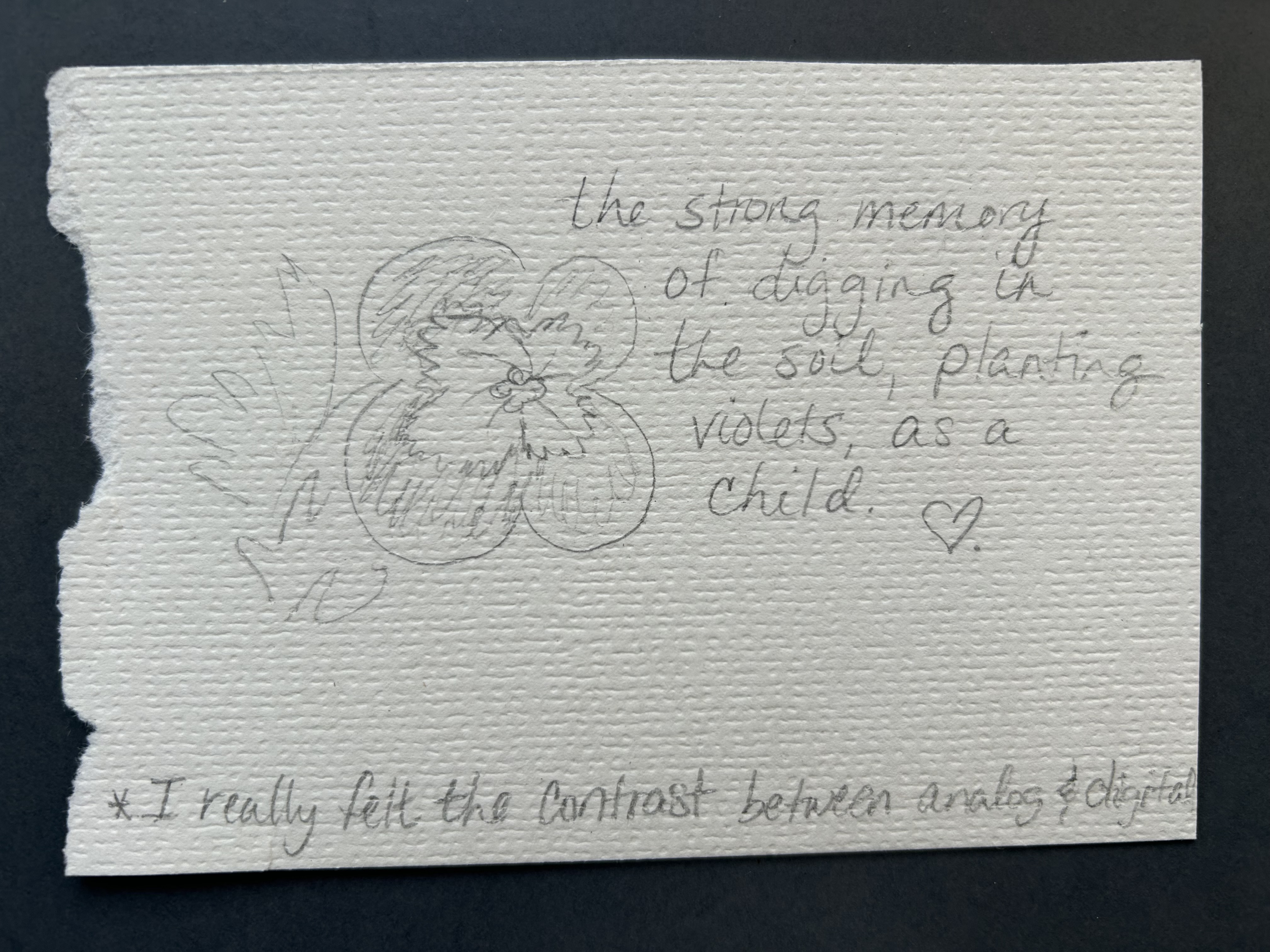
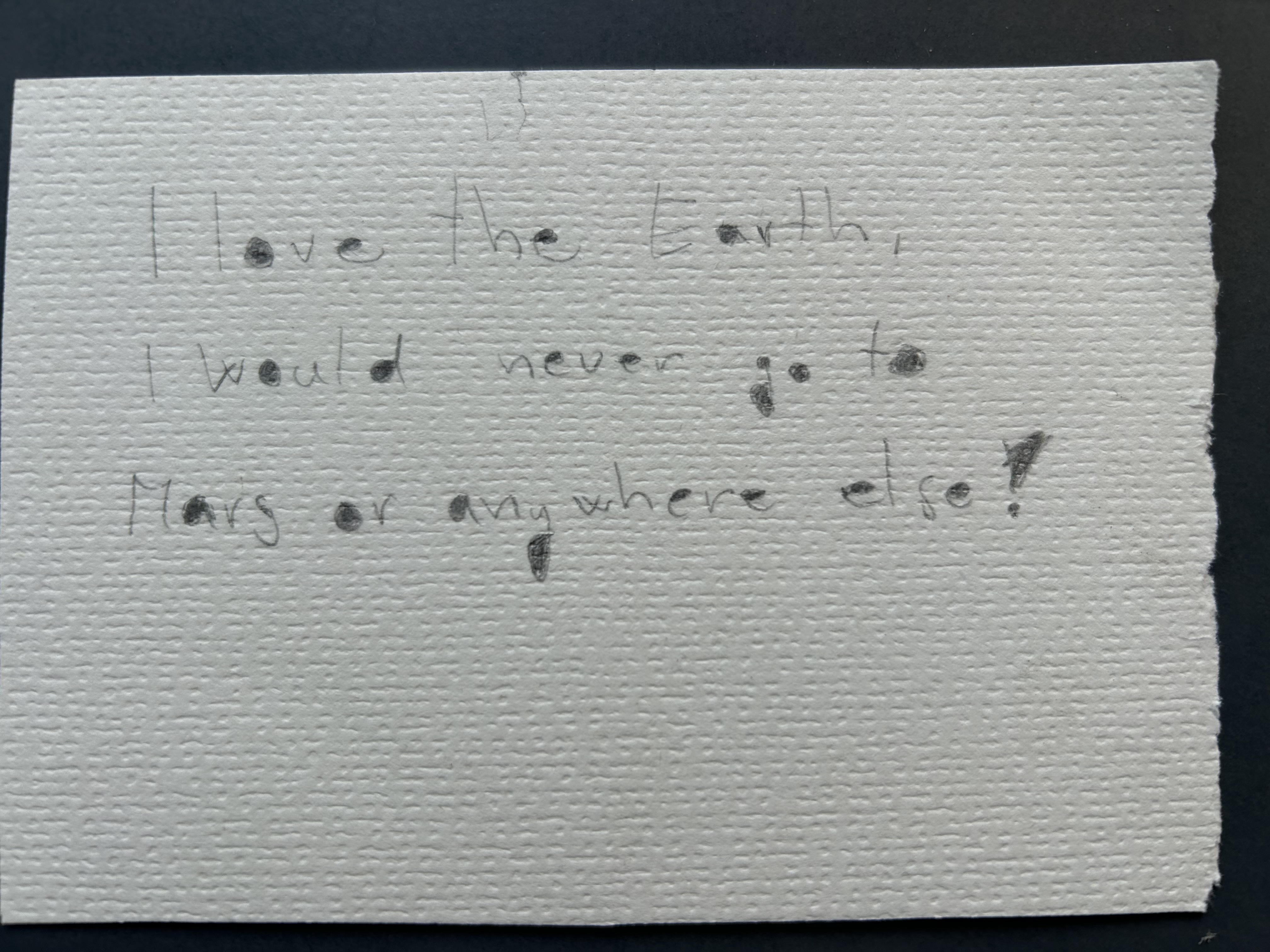
At the end of the experience, rather than moving to the moderated discussion straight away, I gave participants time to process their experience privately first. Each one received a “postcard”, and was invited to respond by writing, drawing, or simply leaving a mark, a trace.
The results were deeply revealing and touching. They allowed a glimpse into the participants’ private and often emotional encounter with the imaginative space I conjured up. The open form of the responses allowed for an extra dimension of expressivity, the possibility of going beyond mere words. At times, the images produced conveyed a sense of an interior world, or a sense of isolation, detachment, distance, or grief. Some participants created minimalist gestures, subtle traces, playing with the composition on the page. Some wrote detailed accounts while others spoke in isolated words, or poems.
What they all shared was an emotional engagement, with words such as: sadness, loneliness, grief, being homesick, anxiety, uncertainty, detachment, being lost – recurring. Others commented on their bodily state, such as a heavy chest, or a faster heartbeat. There were also more hopeful responses, such as: calm, becoming grounded by Earth, faith in return, the need to return, exploring the world like in childhood.
Some of the participants commented on their love of Earth and our need to stay connected. Others appreciated the sensory experience, or the collective aspects at the end. One statement included: “I never want to live on Mars, a world in a plastic cover.” Another one said: “I love the Earth, I would never go to Mars or anywhere else.”
Reflecting on the experience, one participant wrote that it: “made me think that I should appreciate my life on earth my ability to sense, feel, smell, touch, are something that is amazing. As a human I’m a part of the nature. Nature is already very powerful.”
Another one composed a poem:
“Sterility, distant in the darkness,
embraces me.
In the darkest corner,
I will return home once again.”
And yet another one offered: “I have to say that at first I was a little worried, but over time I started to find it more interesting and enjoyable. It was fascinating to see the world through my own eyes after all those years, now that I’ve returned to Earth.
I guess I have two questions: Is there still life on Earth? And has AI taken over the world, gaining power over humanity?”
What my initial experiment showed me is how readily people are willing to enter the imaginary narrative, to engage their senses, including that of their imagination. It raised interesting questions about how artistic methods can be utilised in dialogue with other disciplines, such as science and technology, to create a more visceral, embodied and emotional engagement with participants. By shifting the question from the conceptual and general to the embodied and specific, the performance opened up the possibility of insights that could only emerge through lived experience.


This reflection follows the presentation of A Return to Gravity at Signal Space, Prague, during AI Days 2026, organised in collaboration with TAH.
Photos by Tereza Violet Stehlíková, Sára Hrachovcová and Polina Demianenko
Leave a Reply