Introduction
The introduction gives a personal motivation behind writing this book, which has been driven by the growing need to question and explore the impact of digital and other technologies on meaning-making, while also looking at creative ways to challenge these trends. It introduces the idea that the alienation we feel from our bodies is directly related to our environmental disconnection amidst the ecological crisis. It gives a quick overview of all the chapters and their content to help orient the reader.
Explore related projects:
🔗Tangible Territory journal
Permeability of being
This chapter grounds the argument within the larger context of embodied cognition theory. Using the author’s own experience of growing up in Prague as a case study, she draws attention to the way the environment, including architectural spaces, shapes our cognitive and emotional life. She also explores here questions of atmosphere in early childhood and reflects on how our sense of self is constructed as a kind of assemblage of elements fused together into a narrative that gives rise to a sense of self.
Explore related projects:
🔗 Melusine (2008)
🔗 Familial Traces (2023)
Weaving the senses
This chapter explores the interweaving of our senses, through which we are entangled with the wider world and each other. It examines the way our senses work collaboratively, in a mutual dance of influence. It also looks at some of the more unusual interconnections between the senses, such as mirror touch synaesthesia, which help to reveal the profound entanglements that exist between each one of us and the wider world. At the same time, it provides some of the current scientific theories that help to shed more light on the mechanisms behind these processes.
Explore related projects:
Ophelia’s Last Supper (2018)
Porous screen
This chapter deals with the idea of visual dominance that we, in the West, are experiencing through many of our technologies. It examines the seductive powers of the screen and touches on questions of technology’s potential to expand and deepen our ways of seeing, while also divorcing what we see from its embodied meaning. It also reminds us that the body, despite being overlooked, is always present. It ends with three case studies from the author’s own moving image practice, which all explore the themes of embodied spectatorship.
Explore related projects:
🔗Self-Isolation Dinner (2020)
🔗Zoom Deep Beauty (2021)
🔗Scent of Zeroes and Ones (2024)
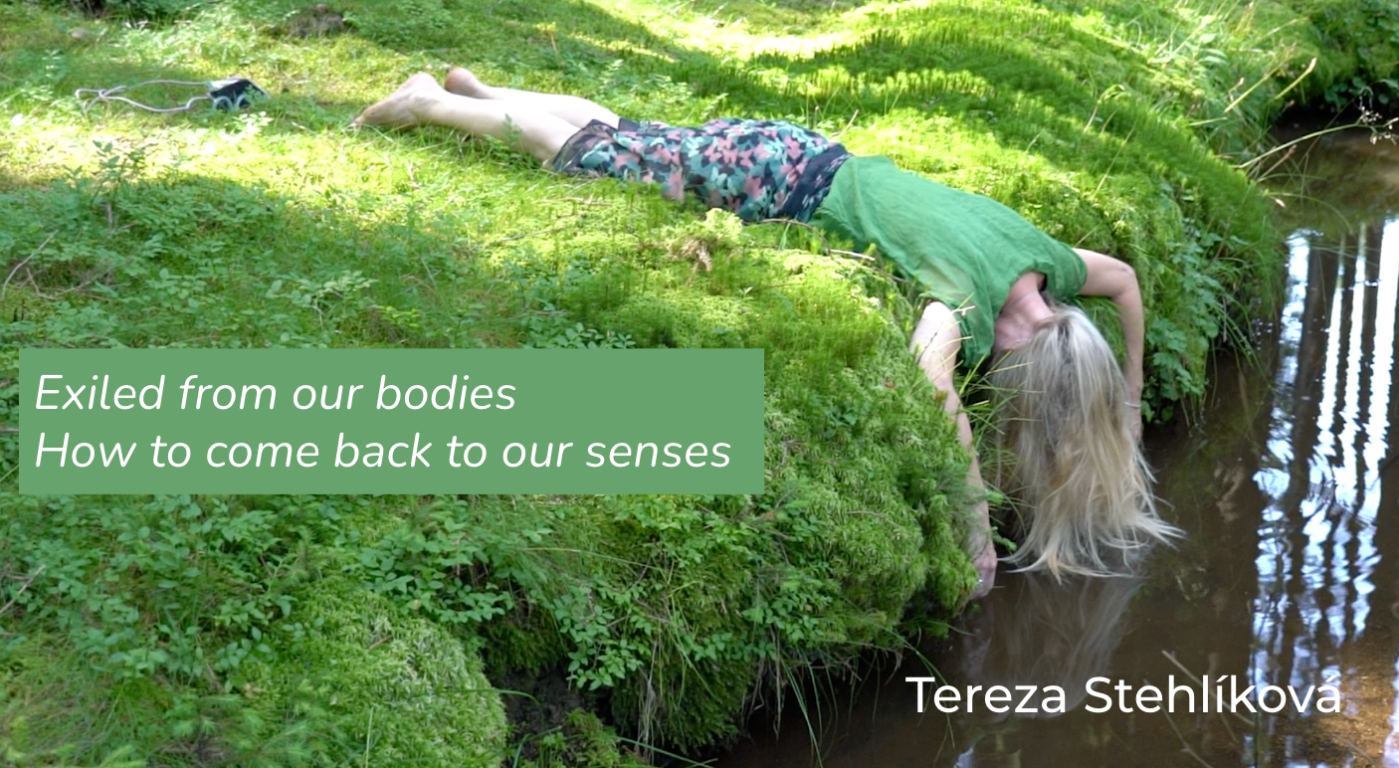
Exiled from our bodies
This chapter delves into the alienating impact of the pandemic lockdown experience. It uses the fictional character of Ophelia, a protagonist appearing in a number of the author’s short films and also her gallery installation, to reflect on questions of our technologically induced disembodiment, a kind of exile from the here and now. It shares accounts from people whose rather extreme experiences demonstrate the profound importance of a multi-sensory grounding, while also discussing various scientific theories that help to explain some of the processes that contribute to these conditions.
Explore related projects:
🔗Ophelia in Exile (2021)
🔗Ophelia in Exile featured in Polyfield magazine
Inside the mirror
This chapter considers our current, technologically mediated experience as an illusion of reality within a mirror world and highlights some of the dangers of pursuing this trend, without reflecting more deeply on what it means to abandon our felt dimension. It discusses the animistic features of our technologies. It warns against the objectification of the body, against seduction of AI intimacy and the dangers of labelling emotions. It invites us to exercise critical feeling as well as thinking and to consider what progress means.
On artist’s knowing
This chapter turns towards artistic knowledge and research methods as a unique way of questioning, examining and paying attention to the current technological trends, as well as the wider world and our place within it. It discusses key concerns of a meaningful creative process, including themes of uncertainty, the role of mistakes, the importance of play, liminality, embodied knowing and process over outcome. It shares the author’s experience of running sensory workshops and ends with her personal account of an immersive performance by Punchdrunk, presented here as a case study.
Explore related projects:
🔗 My sensory pedagogy
Entering liminal spaces
This chapter uses three examples from the author’s own artistic research work, in order to examine the different forms of knowing that making and experiencing art can open up. Specifically, it focuses on various elements of the creative process, all feeding into the creation of a liminal space, where habits can be transformed, new connections explored and novel insights gained. The projects discussed here are: 🔗Across the Unseen Sea: Journey of Unsettling Perceptions, 2013; 🔗Trieste: In-between states, 2016; and 🔗The Infra-ordinary lab, 2023.
Radical hope: Reclaiming agency, defending ambiguity and nourishing multiplicity
This chapter considers the importance of diversity of imaginative responses to tackle the monocultural field of our current technological and media reality. It highlights the relevance of imagination, collaboration, emotion, embodiment, subversion, symbiosis and the vital need of having a greater sense of agency in working with technological tools. It reminds us that our body cannot be ignored and calls for the return to the here and now, that is, the local and directly accessible through our human senses, as the starting place of all change.
Explore related projects:
🔗Nameless Wood (2011)
🔗Living Lab
🔗Reimagining Human-AI Co-Creation Through Tactile Exploration (2023)
 Tereza Stehlíková